
Staged Disasters Down Under: Part 1
Ballantynes' Fire, 18 November 1947 — Death Toll: 41

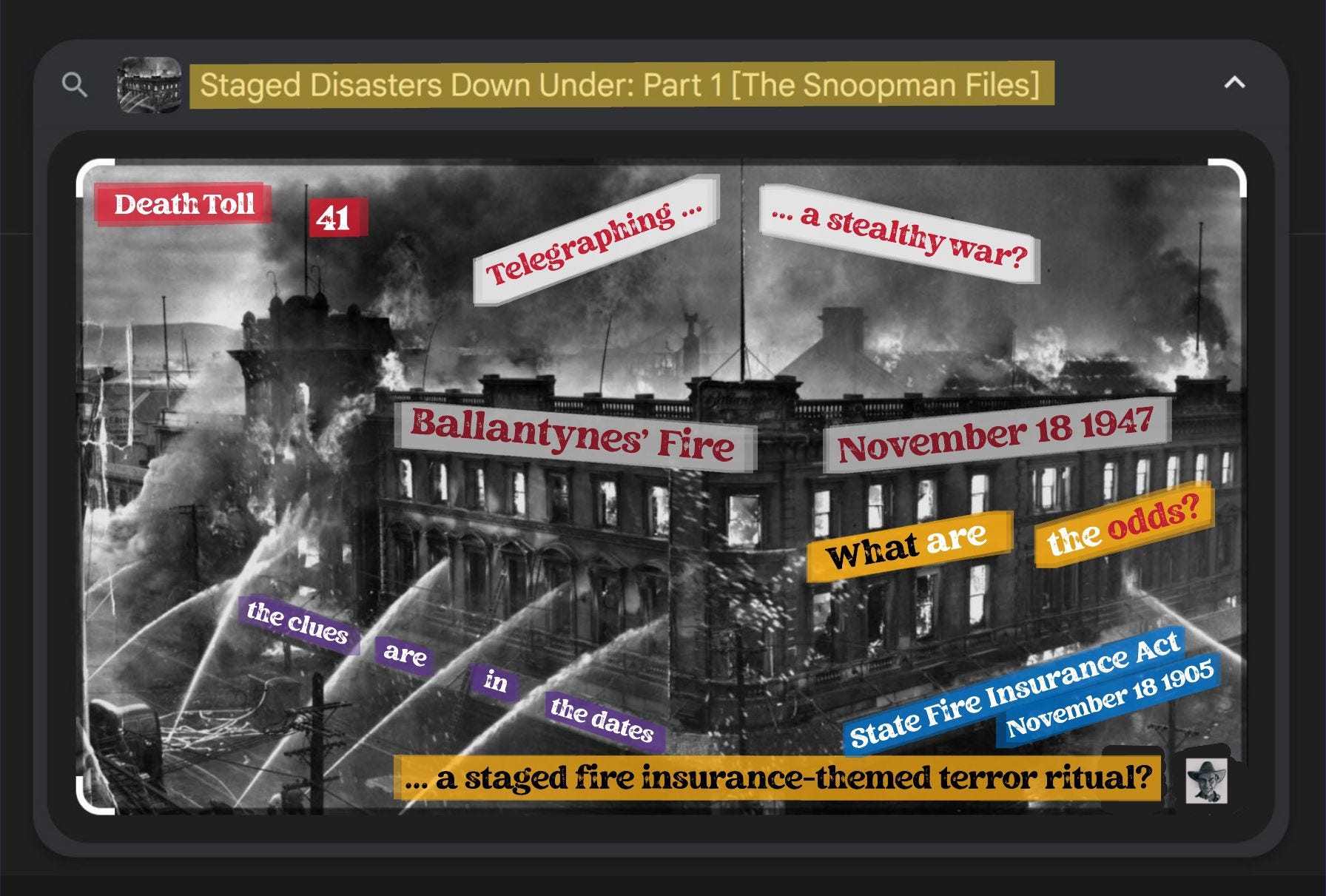
This Staged Disasters Down Under series reveals crises in New Zealand that were thematically encoded with historical riffs to signal authorship, cooperation, promises, threats, scapegoats, and caution — while telegraphing hidden objectives — in plain sight. Staged crises occur with precision timing to riff off historical events so that the newsmaking psycho-dramatic terror theater, simultaneously performs as cryptic signals intelligence, boasts its ritualized spectacular power and functions to maintain discipline among a cryptocracy.Introduction to the Ballantynes’ Fire, 18 November 1947 — Death Toll: 41
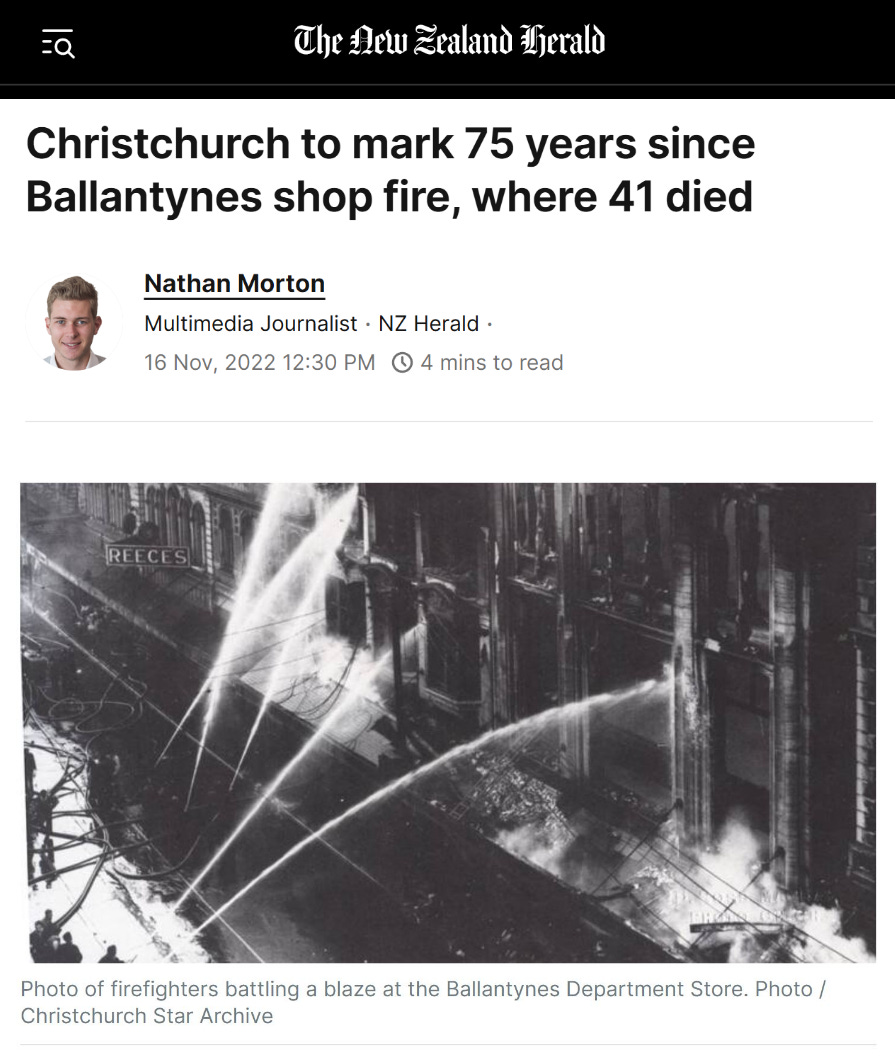
The Ballantynes’ Department Store Fire — that occurred on November 18th 1947, and in which 41 people lost their lives — remains New Zealand’s worst fire tragedy.
One of the enduring mysteries was why so many died in the Credit Office. It was widely reported at the time that the firm’s new director, Kenneth Ballantyne, was the last one out alive. This lent him a ‘captain of a sinking ship’ image. He required rescuing, with numerous ladders and firemen to reach him on a ledge. A movie titled, Ablaze, casts Mr K. Ballantyne as one of the heroes of the fire, and sanitized what really happened in the Credit Office, and failed to re-interrogate an inquiry cover-up.
While the public inquiry led to sweeping changes in building standards, the installation of fire safety equipment and improved firefighting practices, the fire was treated as accidental although the cause itself was never definitively determined. Yet, the prima facie, or circumstantial, evidence reveals a confluence of ‘coincidences’ that were highy suspicious. For instance, the Inquiry didn’t find it was fishy that the firm in the firing line, J. Ballantyne & Company was being audited that day, and that most who died were the accounts and credit staff, because they were made to get the financial records in the fire-proof strong-room. Most died while saving the records.
An up-to-date set of financial records could be presented to Ballantynes’ insurers.
‘Coincidentally’, the firm who rebuilt the department store, C.S. Luney Ltd, just happened to be cutting a hole in the basement between two of the buildings in the complex. Such holes were found to have been fire hazards, since they provided easy egress for the fire to spread to new sources of oxygen and fuel, adding to the fatalities.
But, what every newsroom in the land has missed, is the fact that the fire just happened to occur the very same day the State Fire Insurance Act was passed in 1905. When combined with the coincidences of the company audit and the alterations to the basement structure, this themed historical riffing is the dead give-away that the fire was deliberately staged to achieve far-reaching hidden and deeply dark objectives.

The Ballantynes’ Fire was the first of the post-World War II staged disasters. The tragedy occurred in time for the Royal Wedding of Queen Elizabeth II and her Prince.
Insiders of New Zealand’s ruling families were telegraphing their worthiness to forge a cryptocratic dark state, which first embroiled officials of the Anglican-founded city, as well state officials, in a brazen cover-up. Ballantyne’s was a fire sacrifice ritual.
The ‘failings’ on the day, of a deliberate kind and of an institutionally structural type, where such hierarchical vulnerabilities could be callously exploited to create horror, were anticipated by the mayhem makers and the chaos added to the terror theater.
Former Māori Television news and current affairs editor Steve Snoopman presents the case that the Ballantynes’ Fire was the historical moment when the secret rulers of New Zealand reset the nation’s political trajectory. The Ballantynes’ Fire is the event when a cryptocracy passed the point of no return, causing a permanent severance between the visible public state, and the deep state, to forge a cryptocratic dark state.
This Staged Disasters Down Under series revisits: the Ballantynes’ Fire, 18 November 1947; Tangiwhai Disaster, 24 December 1953; Brynderwyn Bus Tragedy, 7 February 1963; Kaimai DC-3 Disaster, July 3 1963; and the Wahine Disaster, 10 April 1968.
All of these crisis events involved cover-ups that embroiled the Government, and compromised state managers. It is a crisis-addicted system of government by emergency, or as Naomi Klein identified more generally, the application of a Shock Doctrine to exploit naturally occurring crises or to engineer catastrophes to accumulate wealth.
Snoopman decodes pivotal crises whose timings give away that they were thematically designed to riff off historical events, to signal authorship, cooperation, caution, and to telegraph hidden objectives. The signals show players are communicating their cooperation to take a plot ‘live’, convey hidden aims and to broadcast psychopathic humour, thereby posting themselves like ‘hostages’ — as applied game theory predicts.
In music, a riff is a concise musical phrase that is played multiple times to create a recognizable theme within the song. They provide a foundation and structure to the music, often appearing at the beginning of a song or at the start of a chorus. Where a a hook is also a catchy musical idea, and usually only appears once or a few times for greater impact, a riff is repeated as a motif or figure in the melody or accompaniment of a musical composition. In this Staged Disasters Down Under series, the metaphors encoded into the historical date riffs perform as motifs to reveal a narrative arc.
Over the course of hacked time, new district, city and government officials become embroiled in a reset that alters the mandated political trajectory of New Zealand. The spectacle of the staged crisis is unifying, yet totalitarian in nature, because it short-circuits transparent, open government and resets a nation onto a fully-fledged police state path and beyond. The cumulative consequence is that the South Pacific archipelago has been drawn into a stealthy crisis-addicted system of government by emergency, along with other Western nations, to reforge the American Empire.
This far-reaching objective is why the inquiries are part of the cover-up. While such public hearings often provide valuable data about what led to the tragedy, they almost never result in key players being prosecuted and jailed, or rarely come close. Such punishments would be a defection from the undeclared war. There are two exceptions.
Royal Commissioner Justice Peter Mahon suspected foul play was behind the Erebus Crash of November 28th 1979, but the police shut-down their investigation without prosecution under pressure from above. The ‘Mount Erebus Disaster’ was a fire and iced-themed tragedy. Where the Air N.Z. Captain Jim Collins and his air crewmen never saw the mountain straight in front of them, Captain Robert Falcon Scott and his team first sighted the Trans-Antarctic Mountains one year into their polar journey, on November 28 1911. Like Captain Scott, Captain Collins died in the Antarctic ice.
The metaphor-laden cryptic cypher said: move bureaucratic mountains for the envisaged transcorporate heist of the economy, or more mountains will be moved in front of flight crews — without telling them (as happened to Captain Jim Collins).

The second exception, is the case of the infamous Rainbow Warrior Bombing on the night of July 10th 1985. Two of the French secret service agents, who were caught within two days of Greenpeace’s Pacific flagship half sinking at Marsden Wharf in Auckland, pleaded guilty to reduced charges. The Lange Labour Government capitulated to President François Mitterand’s threat to leave the South Pacific to the Russians if Lange did not back off over prosecuting the French DGSE agents. Lange needed to save face. The guilty pleas shortcircuited a trial. Where the French dive team attached the two magnet limpet mines to the hull after dark with a 3 hour delay to ensure the explosions occurred before midnight, French Navy Captain Charles François Lavaud arrived in the Bay of Islands in the French frigate, L’Aube, after dark, on July 10th 1840, on a mission to gain paper sovereignty over the South Island.
Since the origin of the Warrior bomb plot was supposed to remain uncertain, the sinking of the Greenpeace’s ship in Auckland Harbour was intended to nudge Lange’s Cabinet to a calculus that New Zealand was better off inside the ANZUS military alliance. But since the operation went awry, the planned follow-up operation to sink the Mikhail Lermontov on February 16 1986, deepened the Lange Administration’s embroilment in damage control. What are the odds that on the historic date, February 16 1873, the Daily Southern Cross published a hoax story of a fictional Russian warship that invaded Auckland Harbour, taking the mayor hostage? The hoax was to drum up a public outcry for building defence infrastructure to fend off the Russians. The Lermontov was sunk before the cruise ship could traffic guns to French New Caledonia.

Ergo, thanks to the French botching the Warrior plot, we have a proven case of an intelligence agency thematically encoding a state-sponsored terrorism operation with a historical event to signal authorship — while telegraphing hidden objectives. And, thanks to Peter Mahon, N.Z. had a Commissioner who dared to call out foul play.
Albeit, he didn’t realise the takedown of the Air New Zealand Flight TE901 was a fire and ice themed-terror ritual timed to riff off a historical event to signal authorship — while telegraphing hidden objectives. And so, the psycho-dramas continued unabated.
The navy survey ship HMNZS Manawanui, which ran aground on October 5 2024, just happened to riff off the grounding of a container ship, the MV Rena, on Astrolabe Reef on October 5 2011. In turn, the Rena ran aground on the historical date of a secret meeting of the New Zealand Company held in London to negotiate with Lord John Russell for official recognition. The settlement company’s meeting with the Secretary of State for War and the Colonies occurred at a pivotal time, since the nine Waitangi Treaty parchments would arrive in London on November 10 1840, and six days later, the Queen’s Royal Seal would be used on the Royal Charter of New Zealand to erect a colony. In the two years before the sinking of the Rena container ship, there were very few oil and gas prospecting permits granted, while the Key Government repealed the governance over the Foreshore and Seabed Act, to include customary rights. The Rena broke apart on the reef, and the ensuing oil spill was described at the time as New Zealand’s worst environmental disaster. The cryptocracy had telegraphed a threat.
Potently, the Rena’s grounding riffed off the date October 5 1969, that Shell Todd Oil Services commenced drilling for oil at Maui II off Taranaki of N.Z.’s North Island.
In 2024, Luxon had cut the defence budget by $1.5 billion. Luxon metaphorically took a punch to the nose. In effect, the shadow government cryptically communicated that the defence budget was above the Luxon Cabinet’s paygrade. Defence got boosted.

New Zealand’s newsrooms should have noticed the uncanny coincidence of the Manawanui running aground on the same date as the MV Rena hit Astrolabe Reef.
And so, newsrooms missed the deep irony of these groundings occurring with electronic navigation. After all, Astrolabe Reef derived its name from Captain Jules Dumont d’Urville’s ship Astrolabe, after it nearly ran aground there on 16 February 1827. In turn, the name Astrolabe is derived from an early navigational instrument, the astrolabe, a precursor to the sextant — used by Captain Cook. How ironic then, that the Manawanui sank on October 6, given that on the same date, October 6 in 1769, that ‘Young Nick’ sighted the New Zealand coastline aboard Cook’s HMS Endeavour.
Since many of New Zealand’s ruling families established themselves in the Colonial Era, any newsroom possessing a copy of A.W. Reed’s Two Hundred Years of New Zealand 1769-1969, could’ve then perused it pages to find if there was any historical referencing that would shed light on why the Rena grounded. But then, newsroom reporters, producers, and editors would think that such an exercise would be a bit like Jerry Fletcher, the conspiracy theorist taxi driver played by Mel Gibson in the movie Conspiracy Theory, trawling newspapers seeking connections between events that appear unrelated. Fletcher is the victim of CIA-type MK-ULTRA torture inflicted to extract sensitive information. Locked away in Fletcher’s fried mind is the key to a murder of a judge, who was the father of Alice Sutton, a Justice Department lawyer, who Fletcher frequently visits at City Hall, to blurt out his conspiracy theories. And, that mystery leads to a far-reaching conspiratorial plot about why Fletcher is hunted.
Ergo, as a consequence of New Zealand’s newsrooms having a preference to believe in ‘coincidence theories’ fed to them by the archipelago’s cryptocratic dark state, they have missed the cryptic matrix code embedded in the newsmaking disasters that they have been reporting on, for the best part of eight decades. Their cultivated snobbery about diving down stinky filthy dark rabbit holes, has meant they have missed out on scooping the journalistic equivalent of a world class gold seam. Snoopman has found the New Zealand Company’s secret meeting of October 5 1840 reveals the over-arching objectives of a meta-conflict that underpinned why the Rena ran aground.
As a thematic riffing motif codified into the Rena Grounding, this correspondence functioned as signals intelligence that this ‘disaster’ was a staged event. The in-built threat communicated that the cryptocracy possesses the spectacular power to make themed disasters occur at a time, place and of a type of their choosing, by magnitude. Indeed, the cryptocracy was demanding official recognition, or the disasters could be more horrific, more frequent or more targetted, to overwhelm the state’s resources.
It would appear that the transnational oil drilling company, Anadarko, got the jump when it gained approval from the Economic Development Ministry (MED) to conduct seismic testing for oil and gas in the Canterbury Basin, just over four hours after the 6.3M Christchurch Earthquake on February 22 2011. Canterbury Basin extends from south of Christchurch to south of Dunedin. In 2010, Anadarko Petroleum Corp gained approval to operate a frontier exploratory well with Origin Energy Resources NZ Ltd in an area 40 miles east of Dunedin in the southern part of the basin. The February 22 2011 quake, which killed 185, just happened to occur on the historical date, Feb. 22 1962, when the Kapanui Well in Taranaki first produced gas and liquid hydrocarbons.
In Ghoulish Grandstanding Amid Genuine Grief, Snoopman sketched the possible technologies, mechanisms and institutions that may have been harnessed for ‘seismic unrest’. The date meta-data reveals the earthquake was a drilling-themed staged op.
As such, this heretical dispatch teaches snoop-readers how to apply Sherlock Holmes or Agatha Christie logic to Nancy Drew or Scooby Doo enduring mysteries, current crimes and unfolding news events in order to spot-light the spooky darkness.
Key Finding: The Ballantynes’ Fire of November 18 1947 was a ritualized baptism of fire. This horrific ‘worst of type’ fire was deliberately staged as a ritual sacrifice to telegraph a new kind of warfare, where the citizens would be targetted with weaponized mayhem to compromise officials in cover-ups to reset the political center of gravity. The themed date riffing is the dead giveaway. 
This series cites the NZ History website, administered by the Department of Internal Affairs, as well as A.W.Reed’s 1973 compedium of significant events entitled, It Happened Today in New Zealand, and also other sources. News headlines are reworked into collages, with graphical colouring-in by Snoopman. A “Woof” like a Flame-thrower
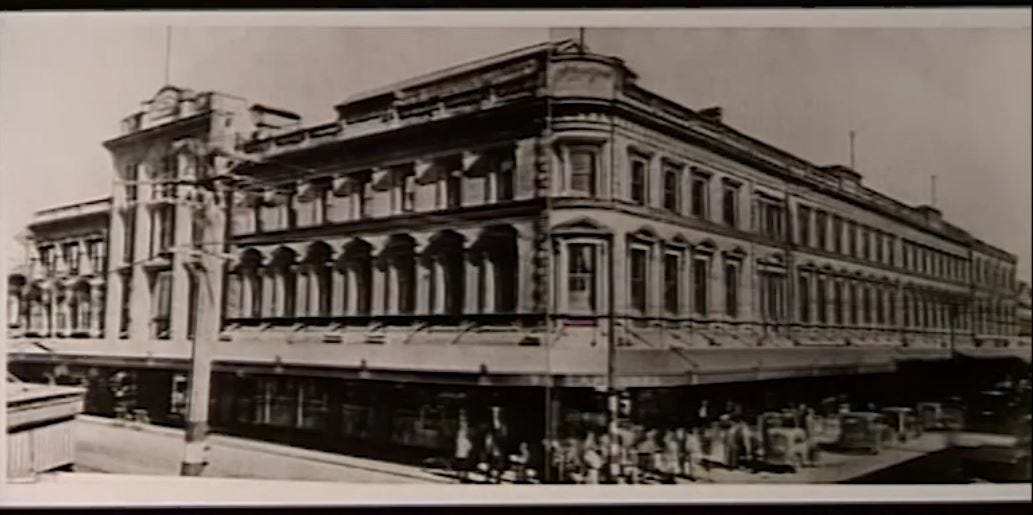
On November 18 1947, a fire ripped through a one acre department store site in Christchurch’s central city killing 41, including a pregnant worker. The Ballantyne’s Fire started in a basement cellar of the Congreves Building at an extreme corner of the one acre site at around 3.25pm, just prior to the afternoon break. Yet, it was able to spread unchecked due to judgment calls made by Ballantynes’ management at the scene, as well as decisions made by the Fire Brigade, especially over raising the alarm.
Smoke was seen at 3.31pm. Yet, the fire brigade’s call log claimed they were not rang until 3.46pm. None of the buildings had fire or smoke alarms, nor any sprinkler systems. The Ballantyne’s Department Store was actually a labyrinthine complex that was comprised of eight sites constructed between 1885 and 1906. Five of the sites functioned as warehouses, maintenance sheds and workshops. There were illegal openings made in walls, which meant the fire could go wild. There were no smoke or fire doors, which meant the lobbies, stairs and lift-shafts became smoke and flame tunnels, vents and chimneys. The complex also included three retail street frontage buildings. The Congreves, Goodmans, and Pratts buildings adjoined one another and each had basements. Two of those basements were linked, by holes in the walls. On the day of the fire, builders from C.S. Luney Ltd just happened to be cutting a hole to link the third basement, as historian Tony Phillips told Brian Edwards in the documentary, Scorched Memories. The anomalies in decisions point to a malicious plot.
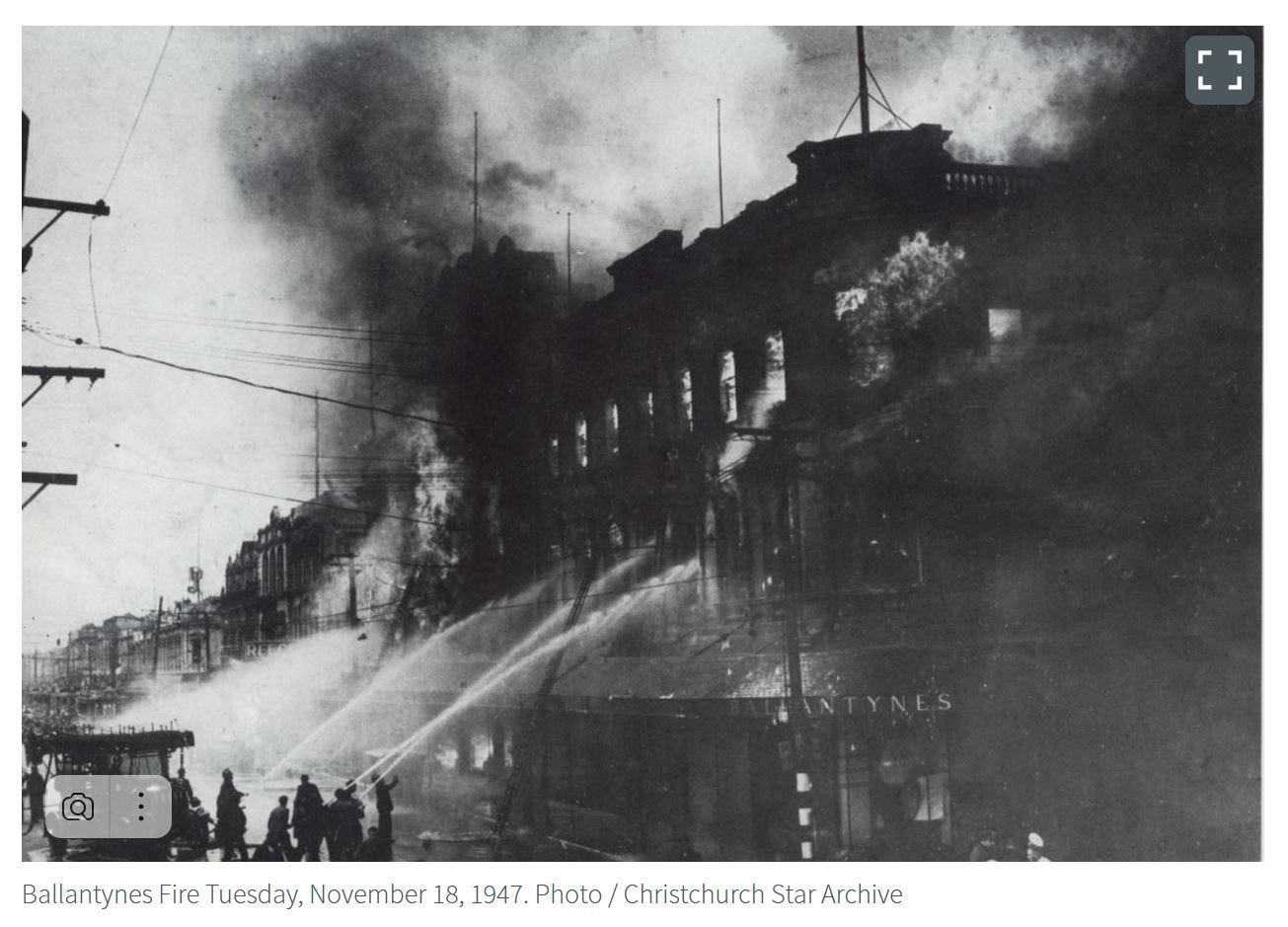
Ballantyne’s staff later confirmed witnessing an earlier call, while Eric Boon’s call at 3.46 p.m. was the first logged by the brigade. The 10-minute delay in placing the call, or in the brigade’s response, contributed to the tragic events that followed, as the Government’s NZ History website records.The fire just so happened to be spreading while a posh afternoon party was underway with a banquet laid on for guests on the second floor. They were awaiting the arrival of ‘Miss New Zealand’. Like a faulty clock, she was late. The guests were ushered out as the smoke rolled in. The Government’s Wellington-based National Film Unit, also just happened to be in Christchurch for another shoot, and was able to process the ‘rushes’ in time for a news-reel for cinema screenings the following evening.
Furthermore, J. Ballantyne and Company was also being audited at the time of the fire.
The accounting room staff were told to get the credit records into the strong-room, while other staff were made to preserve expensive equipment in this fire proof safe — in accordance with the fire insurance policy. Yet, there were alterations made to the building complex that either breached the bylaws or required special dispensations.
The Fire Inspectorate of the Christchurch Fire Board, the Christchurch City Council and the Ballantynes Company were culpable for the loss of life. No prosecutions followed for lax oversight or breaches of fire, building and safety regulations, or for lax standards thereof. No one was held accountable for prioritizing storing credit records and equipment in the strongroom. This wasn’t merely a panic to save the firm.
The fire occurred on the same date when the State Fire Insurance Act was passed on November 18 1905. Insiders of New Zealand’s ruling families were telegraphing their worthiness to forge a cryptocratic dark state. Ballantyne’s was a fire sacrifice ritual.
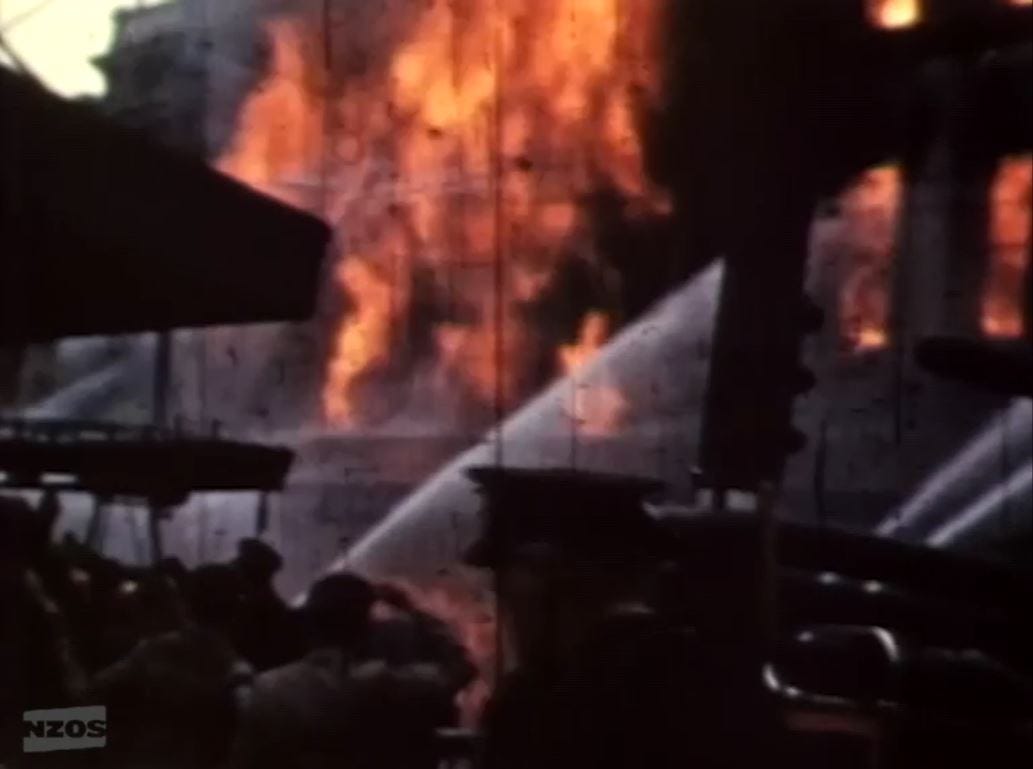
According to the record, at around 3.33pm, a Mr Percy Stringer, who was armed with a fire extinguisher, attempted to quell the fire, but was confronted with smoke so thick he could only hear crackling fire. The lights surged. One of the company’s three principals on site at the time, Roger Ballantyne, reportedly asked if the Fire Service had been called and was told they had been. Kenneth Ballantyne instructed a staffer, Eric Boon, to call the Fire Brigade to ensure they had been called. Mr R. Ballantyne and a worker went into the basement area with fire extinguishers, it was claimed.
At 3.48pm, the Fire Brigade arrived with two engines and one salvage unit to deal with a cellar fire. The Fire Brigade prepared one hose to attack the basement fire, while the commander assessed the scene. Third Officer Jim Burrows was unaware that the fire had been underway for so long, he later told historian Tony Phillips, a former fireman.
At 3.49pm, supervisors commenced evacuation of staff on the ground floor, which prevented the fire service entering the basement area. Smoke was noticed in the fire escape between the Goodmans and Pratts buildings, six feet below the third floor.
At 3.50pm, Kenneth Ballantyne reached the third floor of the Pratts Building, below which were Ballantyne’s main retail floors. Peering into the fire escape, he found hot smoke. At 3.53pm, with lights failing in the Goodmans and Pratts buildings’ upper floors, the Credit Office staff on the 3rd floor, were instructed to store records.
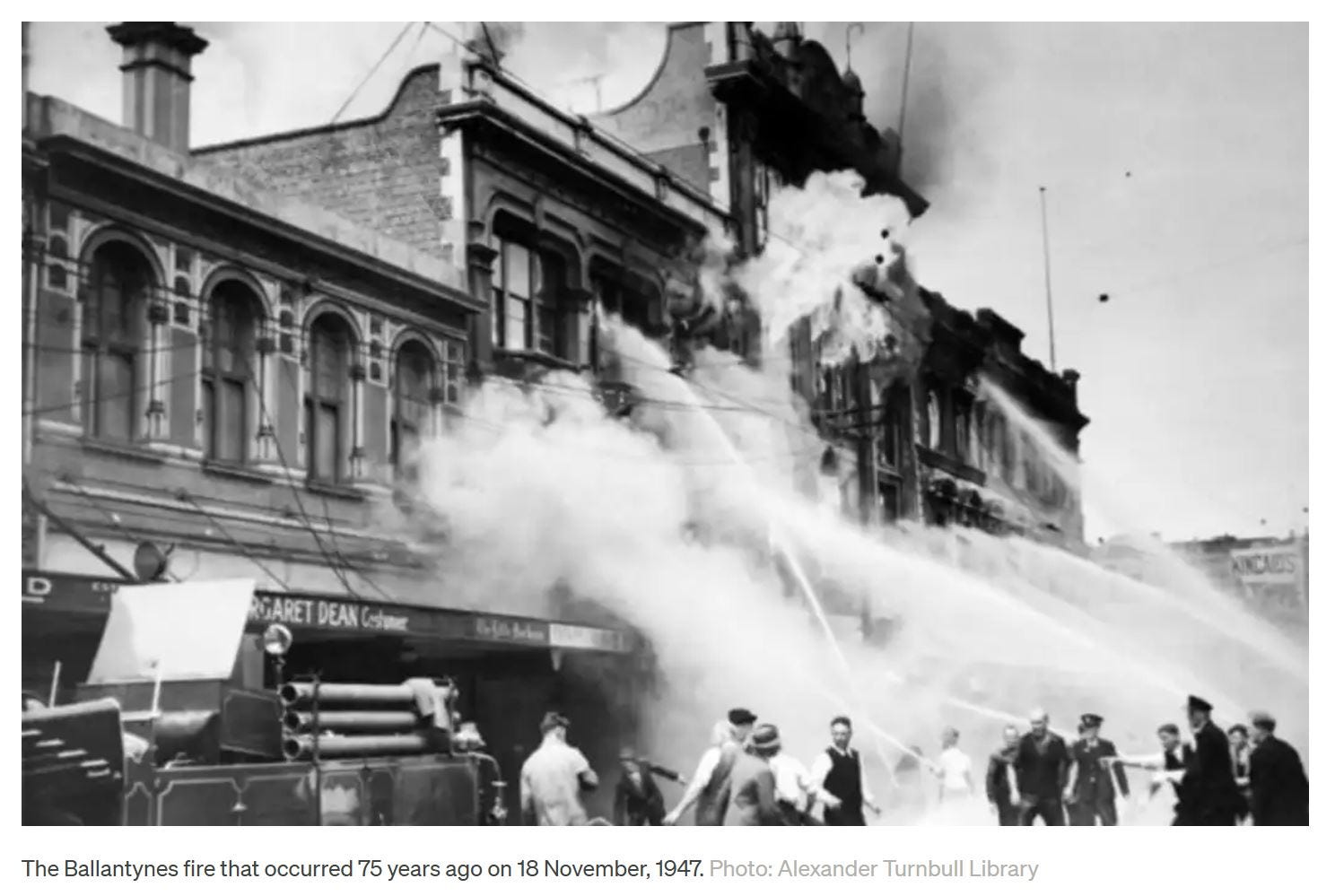
The timing of Kenneth Ballantyne’s arrival at the Credit Office is likely incorrect, to obscure his culpability for the demise of the 31 people. At 3.56pm, eight Millinery Department staff are lead out to make their escape, but only the supervisor and one staffer survive. The others are overcome by smoke. The crowd in the street had been calling out for staff still at the windows to jump, since they had a better vantage point to see the spreading fire and their impending doom.
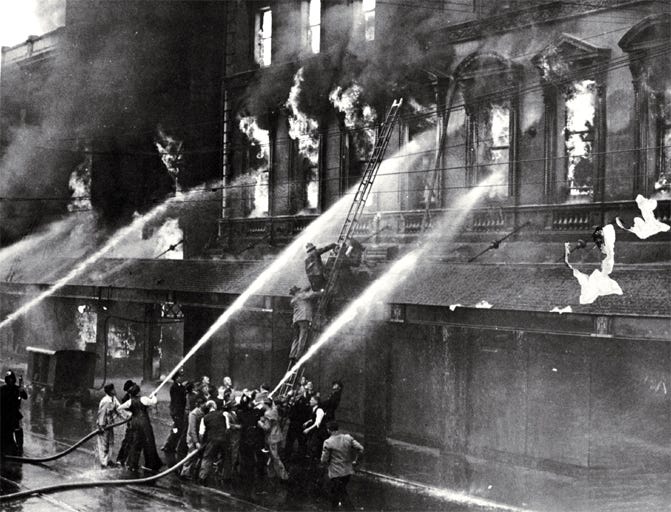
At 3.59pm, ‘flashover’ occurred on the third floor of the Pratts Building. Bernard Hansen said women at the windows were happily waving at the street crowd and then with a woosh, the fire flashed across the floor. They screamed and fell backwards and disappeared into the inferno. Others described the fire travelling at running speed like a flame thrower. They had not realised the danger. Ladders weren’t high enough.
At 4pm, a “Brigade Call” was made by a fireman on instructions of the Third Officer, J. Burrows, which drew engines from around Christchurch. At the same time, the Credit Office stairway in the Pratts Building was cut off by fire, trapping 30 staff. Three women, who narrowly escaped, jumped out a window, but only two survived. The pregnant jumper missed the leap to the adjacent building and died later that day. A fire extension ladder arrived at the chaotic scene. At 4.10 pm, Kenneth Ballantyne is rescued by a fire ladder at the third floor of the Pratts Building and is the last out alive.
Much suspicion fell upon the cellar storeman, Kevin Owen Smith, a smoker, who told the Commission there was no smell of smoke when he left the Congreves Building for afternoon tea. For most of that day, Mr Smith spent his time shining vacuum cleaners in a basement storeroom and he visited Mr Sutherland’s shop following afternoon tea. The Commission accepted Smith’s claim that he never smoked or lit a match in the cellar and Mr Sutherland’s standing as a credible witness giving reliable testimony.
The Royal Commission, the Police and Fire Board did not rigoruously probe for arson.
The basement functioned as storage for furniture, carpets and bolts, and also contained packaging, wooden shelving and services infrastructure such as gas mains, pipes, fuse boxes, electrical wiring and cables. The Congreves basement was adjoined to the Goodmans building via an opening covered with a light wire mesh grille grate.
The Goodmans and Pratts buildings were separated by an alley way just three feet wide. An opening to this alleyway had been cut, which enclosed the fire escape from the Pratts Building. The fire had easy egress to much of the one acre, block located on Colombo, Cashel and Lichfield Sts, south of Cathedral Square.
Most staff died inside the Credit Office. Contrary to the impression created by the National Film Unit newsreel that first played on November 19 1947, a lackluster Fire Brigade response compounded the reprehensible reactions of the department store managment to order the Credit and Accounts staff to save the company records and gear, as well as other management to carry on a ‘business as usual’ act, as the building filled with smoke. Moreover, the Ballantynes’ Fire Horror Show was found, predictably, to have been a ‘disaster waiting to happen’, since the breaches of the building, fire and safety codes were lined up like the charred bodies in the mass grave, when the Court of Inquiry authorized by Fraser Labour Government, was over.
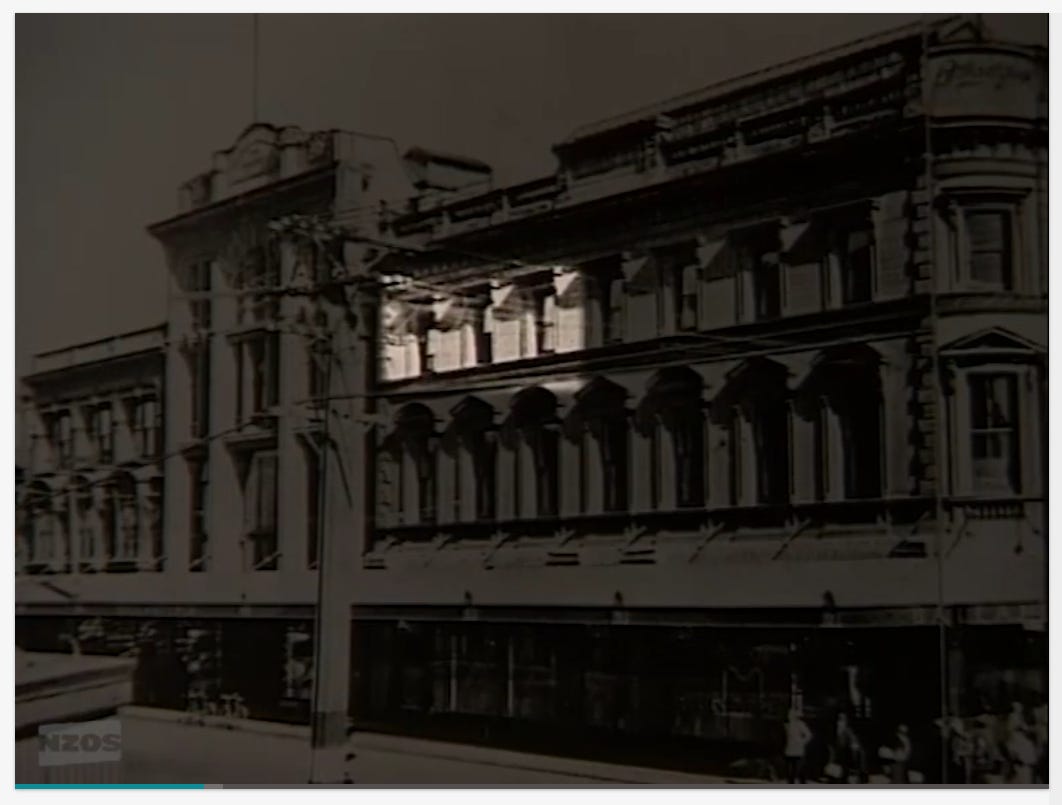
To sum up, the first fire call was allegedly made 15 minutes after fire was discovered. The first evacuation order was given 17 minutes after the fire was first discovered, but limited to the ground floor only. The first water was applied to the fire 11 minutes after the fire brigade arrived, and this was 26 minutes after fire was discovered. Flashover had occurred on the third floor of the Pratts Building 28 minutes after fire was discovered, while the top floors of the Pratts and Goodmans buildings collapsed approximately 40 minutes after fire discovery. The closest Fire Station was two minutes away. Of the 41 who perished, 38 were staff, one was a College of Retailing employee, and two were external auditors. The firm’s records survived, while the auditors were terminated, along with most of the firm’s accounting and credit staff. Canterbarians were supposed to believe that the Fire Brigade didn’t receive any calls any earlier than 3.46pm, despite the smoke rising from the department store.
The Ballantynes’ Fire was staged as a ritual of sacrifice, terror and spectacular power to capture state, city and provincial officials, as well as the fire board and corporate executives and management to create a permanent severance between the visible public state and the deep state, or what Snoopman calls the cryptocratic dark state.
What are the odds that the country’s worst building fire would happen on the historical date that Parliament passed the State Fire Insurance Act? And what are the odds that the accounts for J Ballantyne and Co. Ltd had been prepared for an audit that very day? This ‘coincidence’ meant that since the records were preserved in the strongroom, the financial statements could be presented for fire insurance purposes.
The dead auditors were from the firm Stewart, Beckett and Company.
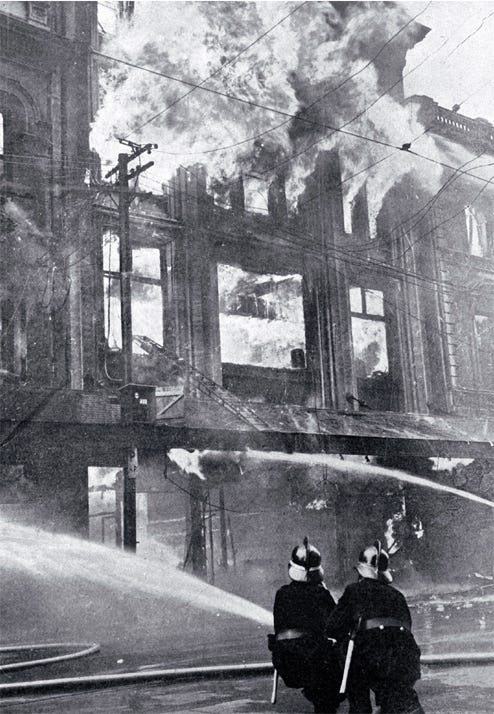
On January 27 1948, Christchurch Provincial Chambers Inquiry commenced. It was found that while the architect for J Ballantyne and Co. Ltd knew about the dangers of lateral and vertical openings that had been made in the buildings would allow the spread of fire, without fireproof doors. He was also aware of the dangers regarding unenclosed liftwells and stairways, lacking fire proof protection. However, he downplayed the issue and claimed they give didn’t much attention to the fire question.
And so, what are the odds that the day of the fire — that occurred on the historical date that Parliament passed the State Fire Insurance Act — builders from C.S. Luney Ltd just happened to be cutting a hole to link the third basement?
Charles Luney’s firm built the new store in four stages and was completed in 1964. The Christchurch Press reported on December 17 1963 that Ballantynes’ had over the the intervening 15 year period consolidated its position building in stages, after buying the adjoining sites it did not own, in 1948. The last stage started Jan. 13 1964.
The brick and stone-walled buildings adjoining Ballantynes that weren’t compromised with improvised openings in walls, did not become engulfed.
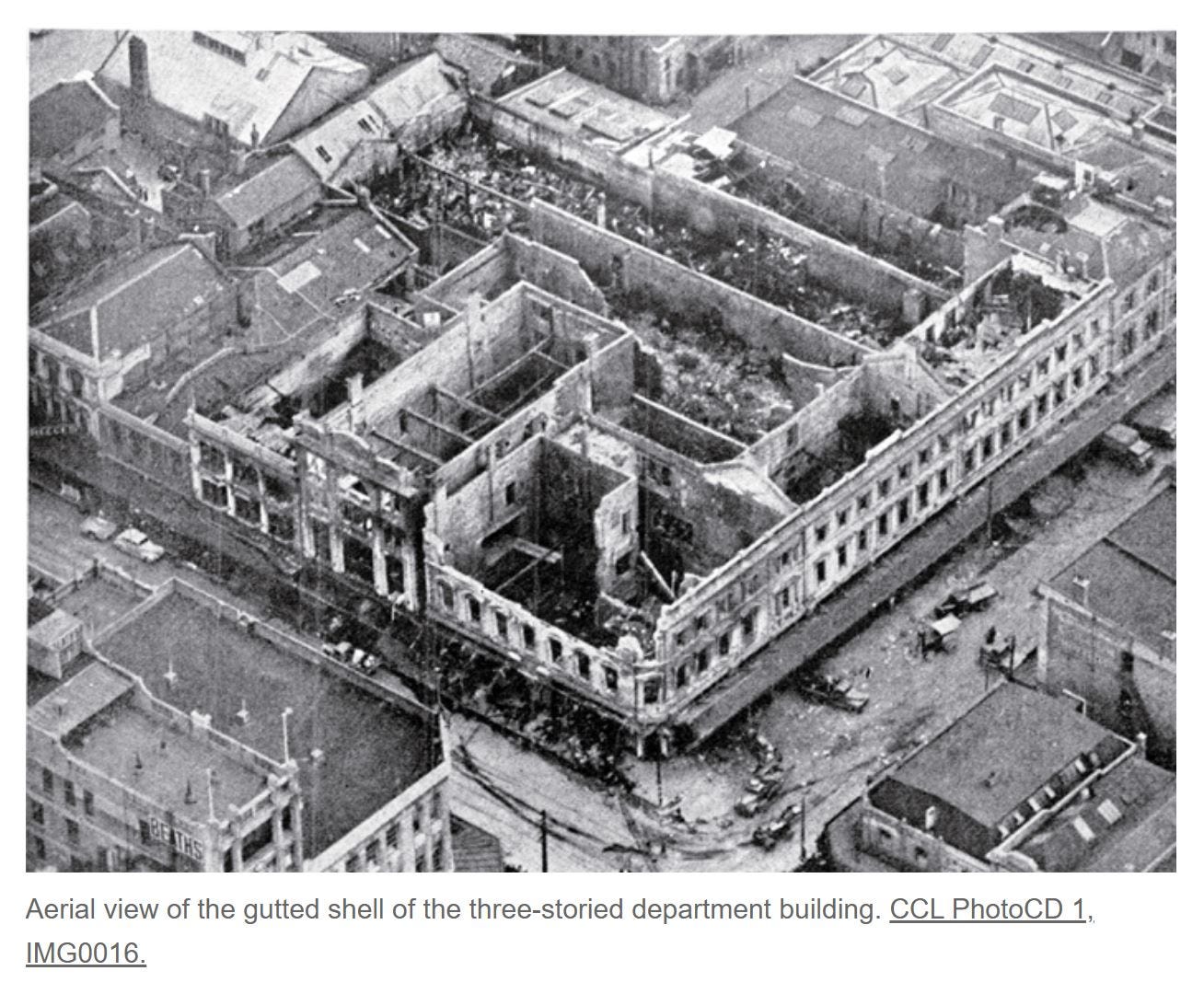
The Congreves cellar was below the Furnishings Department of Ballantynes. Ergo, there was plenty of fuel for a fire to rapidly grow into an ferrocious inferno. In Wilson and Horton’s 1987 edition of New Zealand’s Darkest Days, Bruce Morris sanitized the reasons for the high loss of life on November 18th 1947, this way:
“Ballantyne’s employed more than 300 people and 38 of them — along with two accountants and a woman with an office in the block — died that day in the country’s most ghastly fire. Yet no one should have died. A more efficient fire brigade and superior company evacuation procedure and adequate alarm system could have saved all the lives.”
Morris neglected to mention two auditors died that day. He also neglected to mention that 30 staff died in the Credits Office on the second floor of the Pratts Building.
Tellingly, there were two staff who died in the second floor credits/accounts room, that were employed elsewhere; one was from the Telephone Exchange and the other was employed in the Display Studio; both were located on the Goodmans Building’s 3rd floor. The pregnant Credit Office lady died after jumping from the second storey. The two non-Credit Office staff is a dead giveaway they died saving valued firm assets.
Despite both Roger and Kenneth Ballantyne becoming aware of a fire, at 3.33pm and 3.45pm, respectively, neither of them give an evacuation order. In a hierarchical institution where obedience and loyalty were measures of worker worthiness, this failure to issue a call for all staff to evacuate immediately was not punished. Kenneth was aware the fire had been underway for at least 10 minutes, reported Brian Edwards.
The seasoned journalist said there was a discrepancy between Kenneth Ballantyne’s portrayal of events, and that of Credit Room worker Nancy Nash. Mr K. Ballantyne claimed at the Inquiry that upon entering the Credit Office he said “with 10 or 15 seconds he told the girls to make their way down the tailoring stairs”. However, Nancy Nash told the Inquiry that Kenneth Ballantyne was in the Credit Office for five to six minutes, while staff were acting on instructions from Mr Hudson were putting away records in the strongroom. In 1997, Mr B. Edwards cast doubt on the credibility of the Ballantyne Company director when he spoke directly to camera and therefore to his television audience, from the Christchurch Provincial Chamber where the inquiry took place. He said, are we to believe that 20 women heard an order from the company director to evacuate and they ignored him. He added, the records were put away in the strongroom, taking five to six minutes, and the staff were put in grave peril. Nancy Nash said the flames were coming up through the floor boards when she jumped.
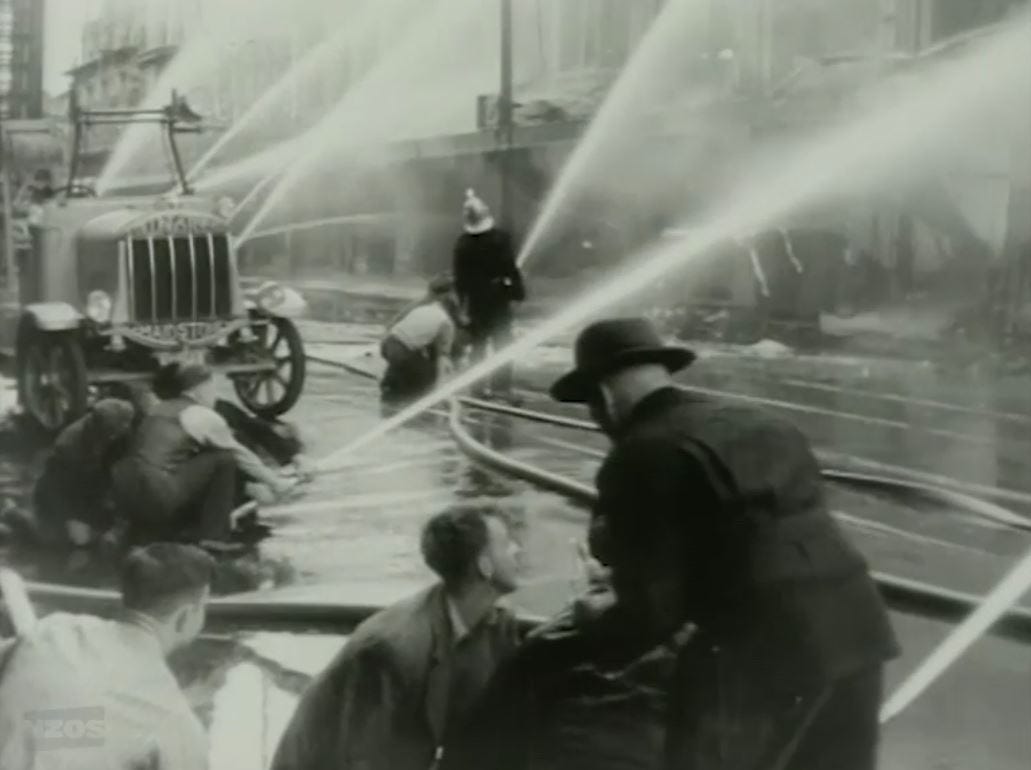
Lois Kennedy, who also survived the jump, said in her testimony, that 25 bins, two typewriters, three or four adding machines and a number of boxes of records were put in the strong-room. Kennedy Ronald Ballantyne told the Commission that virtually all the records of the credit department were saved, and also part of the accountancy records. They were found in the strong-room. The Commission stated “... valuable time was used in preserving records of the company at a time when a way of escape was open.” Huge changes to fire fighting and laws occurred in the aftermath.
In Scorched Memories, historian Tony Phillips defended fire officer J. Burrows, who committed half his resource while finding the areas to attack the fire. Yet, Phillips did wonder if the firemen devoted themselves to an evacuation, the toll might’ve been less.
The initiative for an evacuation was eventually taken by individual staff members who cleared their areas of fellow staff and customers as the volume of smoke increased.
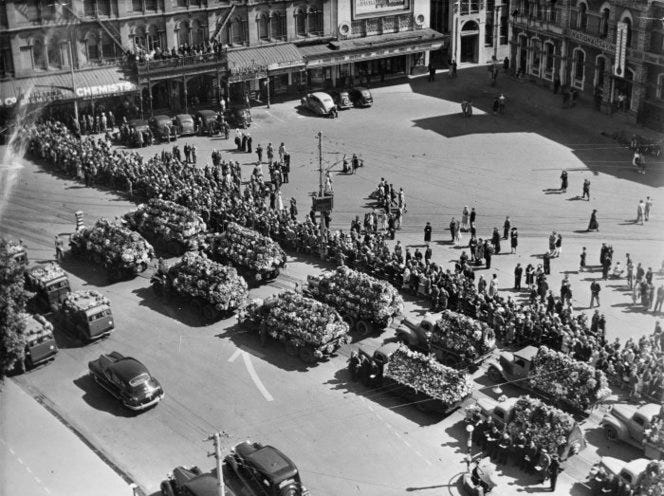
None of the bodies, or parts thereof, recovered from the gutted buildings were identifiable. And so, on November 22nd, a police photographer bore witness to each of the numbered bodies being placed in caskets. On November 23rd, the Anglican-founded city stopped. A funeral for the 41 dead took place at the City Cathedral, followed by a procession of 41 wreath-laden trucks carrying caskets. People lined the route for 4 kilometers, and 10,000 attended the mass burial at Ruru Cemetery.
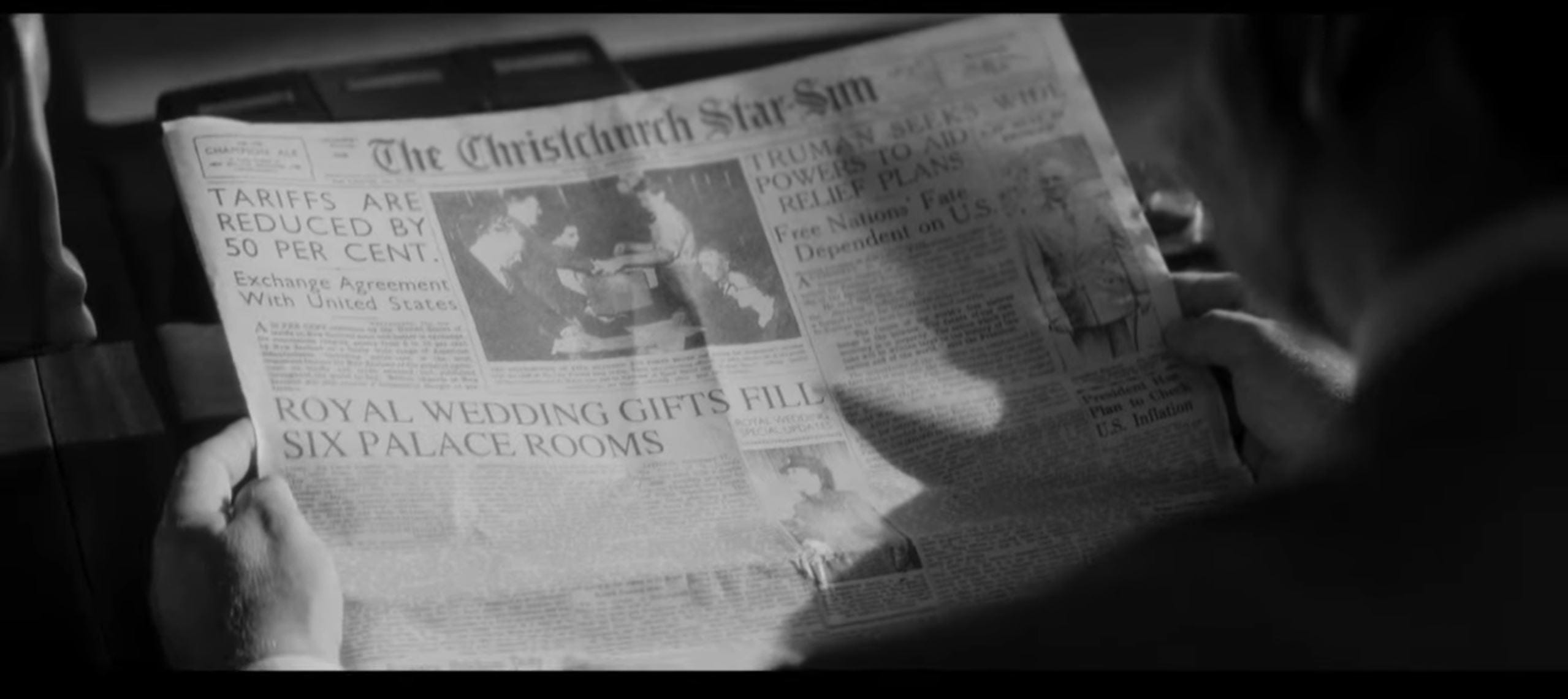
This fire occurred two days before the Royal Wedding of Queen Elizabeth II and the Duke of Edinburgh, Prince Phillip. In all, 200 firemen and 20 engines had attended the Ballantyne’s Fire. The horrific fire was deliberately staged as a ritual sacrifice to telegraph a new kind of warfare, where citizens would be targetted with weaponized mayhem to compromise officials in cover-ups, and reset the political center of gravity.
The cause of the fire was never definitively established and controversy over whether it was a disgarded cigarette or an electrical fault has deflected attention from the truth.
In Scorched Memories, made for the 50th anniversary, Brian Edwards said no one was prosecuted despite broken laws, inept leadership and poor judgment at the scene.
While the commission recommended sweeping changes for fire prevention and firefighting in New Zealand, and called for wide-ranging amendments to legislation to better regulate buildings for fire safety, such standards, practices and regulations existed overseas. Moreover, the fire safety and fire fighting technologies also existed.
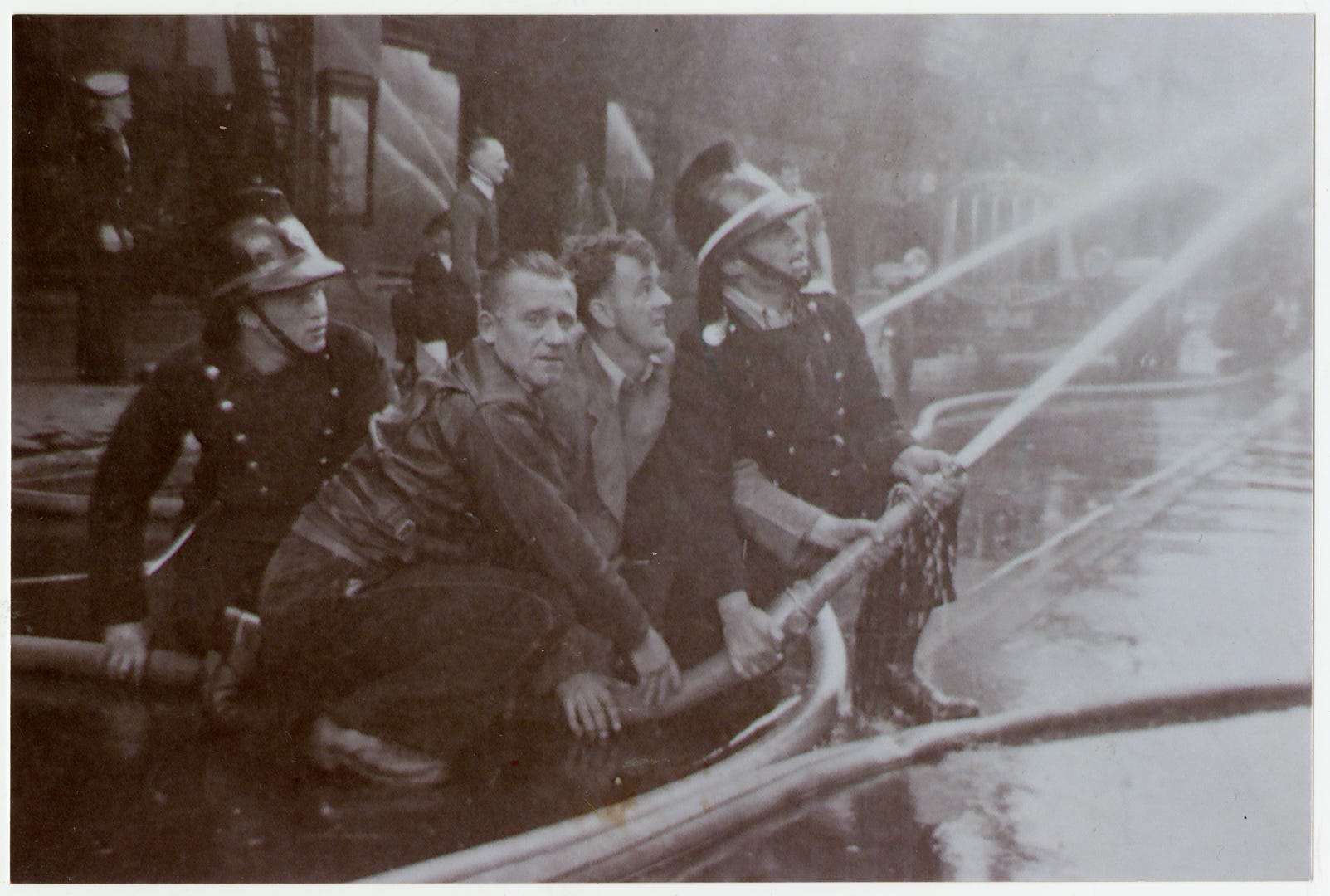
This fire terror theater galvanized action for building material upgrades, including reinforced concrete for commercial structures, as well as the installation of fire safety equipment, which coincided with the post-war immigration and economic boom.
And, at the Commission of Inquiry held at the Christchurch Provincial Chambers, Edwards added, “one question was never asked: were the deaths of 41 people avoidable?” The themed date riffing is the dead giveaway that the fire was staged.
Ergo, the reason no one was prosecuted is clear. The culprits were instigating a far-reaching diabolical sabotage strategy to take the country totalitarian — by stealth.
The emergent cryptocracy had displayed their prowess, callousness and gall for staging a brazen ritualized fire sacrifice on the same date that the State Fire Insurance Act was passed in 1905 — before the colony graduated to Dominion status.
The Ballantynes’ Fire was the debut of themed historical date riffing to be deployed as a cryptic motif making sly appearances in staged disasters, crises and other catalytic news-making events. The ‘coincidental’ presence of C.S. Luney Ltd, the external auditors and even Miss New Zealand on the same day the National Film Unit was in town and could switch to shooting the nation’s worst fire tragedy — were incredible.
The timing of the store’s pre-Christmas promotional function with Miss New Zealand, Mary Wootton, also booked for a fitting at 4pm, worked as a drawcard. This confluence indicates a choreographed distraction while the arsonists performed their tasks like clockwork. This function added to the perceived need to keep up a business as usual appearance, which would delay or avoid a store-wide evacuation order, and it had added value to heighten the anxiety, the drama and the catharthsis.
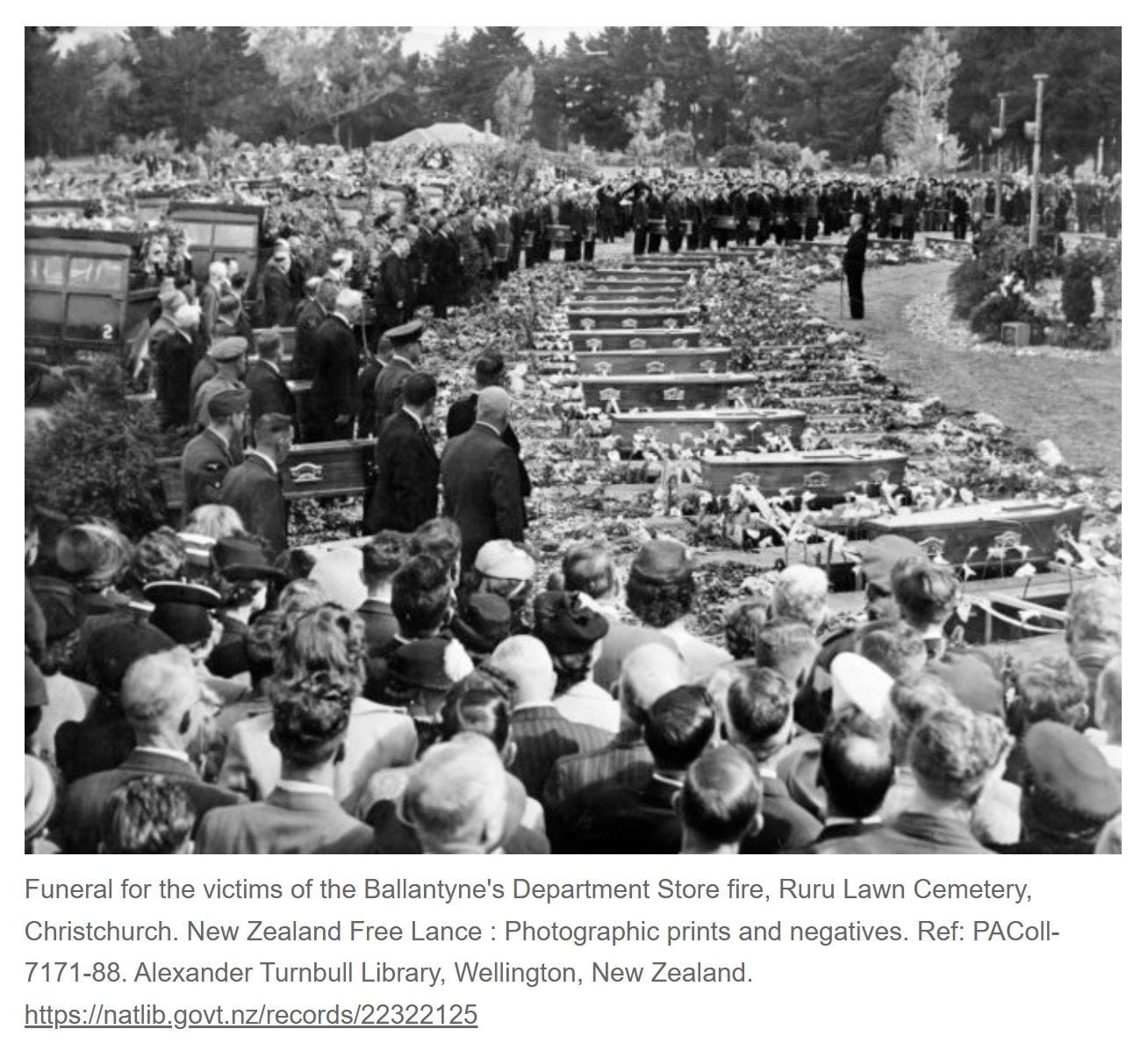
The ‘failings’ on the day, both of a deliberate kind and of an institutionally structural type, were anticipated by the mayhem makers, and chaos added to the terror theater.
The narrative arc unfolded as a busy day for the executive, retail management and operations, five weeks out from Christmas a few years shy of the city’s 100th anniversary. On the very day of an external audit, a basement hole cutting job, and a function featuring a beauty queen, a fire broke out in a cellar at one corner of the Department Store. Amid the cacophony, contrived confusion, controlled chaos and callous cowardice plays the staff, guests and shoppers like pawns caught up in a cruel chess game. While valuable time is whittled away, the delayed evacuation hampers the firemen, and panic sets in as the accounting staff realise the time they spent obediently saving the company’s precious financial records has cut off the fire escape routes. Many were either too frightened to jump. They perished — either overcome with smoke, or were burnt alive. The firm’s director is the last to be rescued from a third floor window ledge. In the movie, Ablaze, he is cast as a hero; the myth is set.
The fire also riffed off a fire tragedy linked with New Zealand. On November 18 1874, an immigrant ship bound for Auckland, caught fire. The Cospatrick sank off South Africa’s Cape of Good Hope. Only three survived. Although the tragedy happened far from New Zealand, it has been described as N.Z.’s worst civil disaster with 470 dead.
The key enduring mystery of the Ballantynes’ Fire can be unbraided with a ‘roles reversal’ question. Would so many credit and accounting staff have died while saving the firm’s financial records, on the same day an external audit took place while a basemment level hole was made to join two of the buildings, if on the same day the drawcard for an afternoon function was the royal queen rather than a beauty queen?
Regardless, the Ballantyne’s Fire remains New Zealand’s worst fire catastrophe and it was classed as a ‘disaster’. Yet, the cryptic fire insurance-theming reveals its staging.

If you haven’t yet subscribed to The Snoopman Files, you must be super-retarded.
Post-Script: Snoopman’s father told him that he designed a sprinkler system after the Ballantynes’ Fire. The design was a thin copper wire connected to thin glass bulbs that would break with heat, and the broken electrical circuit would set off the sprinkler system. He sent the design to the DSIR in Wellington, since NZ didn’t have a patents office. He wasn’t very business savvy. He was a trusting working class electrician, who’d been a radio operator in the Royal New Zealand Air Force, during World War II. He told Snoopman that about two years after the fire, his sprinkler design was distributed in N.Z. through the Wormald Fire and Security Company (US).

Back when Snoopman was ‘Snoopboy’, he delivered the Auckland Star during the exciting days when Pope John Paul II and President Ronald Reagan survived assassination attempts. There was also a cervical cancer scare linked to tampons. But, the lead story didn’t say what exactly was a tampon. No one on his paper-round would tell him. Ever since, Snoopman has noticed when context in news is missing.
Editor’s Note: If we have made any errors, please contact Steve Snoopman with your counter-evidence. e: steveedwards108[at]protonmail.com
SEE related story: Tangiwai Railway Disaster, 24 December 1953 — Death Toll: 151 Staged Disasters Down Under: Part 2
See also the Series: Darkest Days by Dates Down Under
Another 'event' to ponder over. Thanks for your diligent analysis Steve.
Another great piece, thanks.
"Post-Script: Snoopman’s father..." -- incredible, but not surprising. DSIR!